
he first time you walk into the Maracanã, the scale is disorienting. Not the seats—those are ordinary enough—but the void. The roof, a delicate white arc, seems to float above a bowl that could swallow a small town. On a quiet afternoon, with only maintenance crews and a few stray pigeons, you hear your own footsteps echo off the concrete. It’s a strange intimacy for a place built to hold nearly 200。000 people. That was the original capacity, before safety regulations and seating converted the terraces. Now it’s closer to 78,000, but the ghost of the old number lingers in the wide, sloping ramps and the cavernous concourses.
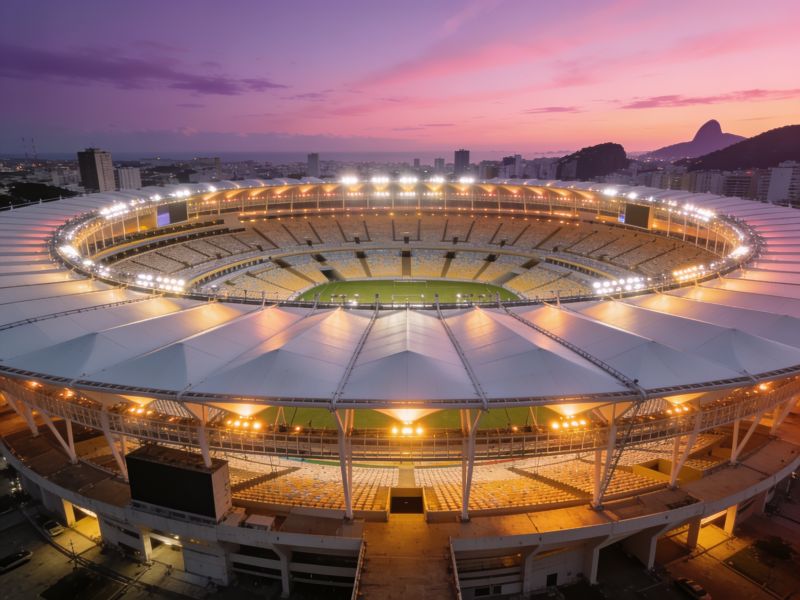
I went there on a matchday, not for a classic Fla-Flu derby, but for a mid-table league game. The crowd was sparse by Maracanã standards—maybe 30。000—yet the noise was relentless. A single drum section in the south stand kept a samba rhythm going for ninety minutes straight. No one sat. Old men in faded Flamengo shirts leaned against the railings, shouting instructions to players who couldn’t possibly hear them. A boy next to me, maybe eight years old, explained the offside rule with the patience of a professor. This is the Maracanã’s real function: not a monument, but a living room for the city’s football-obsessed soul.The stadium’s history is often reduced to two moments: the 1950 World Cup final。where Brazil lost to Uruguay in front of a reported 199,854 spectators, and the 2014 final, where Germany dismantled Brazil 7-1. Both are treated as national traumas, but the Maracanã has hosted far more mundane dramas. I remember a Copa Libertadores match in 2019 where a last-minute goal sent the home crowd into such a frenzy that the concrete actually vibrated under my feet. That’s not hyperbole—engineers have studied the structural resonance of celebrations there. The place absorbs emotion and gives it back as physical force.Renovations for the 2014 World Cup cost over $500 million, a figure that still sparks arguments in Rio’s bars. The roof was extended, seats were installed, and the pitch was lowered to improve sightlines. Critics say the soul was sanitized. They have a point: the old general admission terraces, where fans stood shoulder-to-shoulder。are gone. But the Maracanã’s character isn’t in the concrete. It’s in the way a goal celebration ripples through the stands like a wave, or how the floodlights catch the mist rising from the pitch on a humid night. You can renovate a stadium, but you can’t renovate the rituals that fill it.
Walk around the exterior on a non-match day and you’ll find a different Maracanã. Vendors sell cheap sunglasses and phone cases on the sidewalk. A group of teenagers plays futsal on a concrete court nearby, using flip-flops as goalposts. The stadium’s shadow stretches across them, a reminder that the Maracanã isn’t just a venue—it’s a landmark that shapes the neighborhood’s daily rhythm. I asked one of the teenagers if he’d ever been inside. He shrugged. “Too expensive” That’s the paradox: a cathedral of football that many of its neighbors can’t afford to enter. Still。they play in its shadow, and on matchdays, they gather at the gates to listen to the roar. The Maracanã belongs to them in a way that no ticket price can measure.